 cerne
cerne
How to know yourself better, one sentence of yours at a time

You have taken the tests. You know your type, your four letters, maybe your number. And still, on a Tuesday night, you cancel the dinner you said yes to, and you could not tell anyone why. The label did not help. It described you from the outside and left the inside exactly where it was.
Knowing yourself better is not a quiz result. It is being able to say, in your own words, what happened, what it stirred, and where you learned to react like that. This text gives you a way to do that: five questions in an order that works, a rule that keeps you honest, and three small things to do this week.
The golden rule: a conclusion about you needs your own sentences
Anyone can hand you a conclusion. A friend, a book, a chatbot, a horoscope. The problem is that a conclusion that did not come from something you actually said has nowhere to hold on to. It sounds true for a day and then slides off.
So here is the rule for everything below. Before you accept any sentence about yourself, ask: which of my own words is it made of? If you cannot point to two or three things you said or did, it is a guess, not knowledge. If you can, keep it. It is yours.
How to know yourself better, starting today
Start small and start with something that hurt. Not your whole personality. One moment. The meeting where you went quiet. The message you rewrote four times. The Sunday you spent at the desk.
Take that one moment and describe it the way a camera would. Who was there, what was said, what you did. No interpretation yet. Most of us skip this step and go straight to “I am just like that”, which is where the knowing stops.
Then ask what it stirred. Not what you should have felt. What you actually felt, even if it sounds small or wrong. Write the sentence down exactly as it comes. That sentence is a fragment, and fragments are the raw material of everything you will learn about yourself.
How to know yourself deeply, not just on the surface
Surface is what you do. Depth is why you keep doing it. The difference between the two is usually one question: has this happened before?
When you answer honestly, you find the second and third time. The other meeting where you went quiet. The other job where you said yes to everything. That is when a single moment turns into a pattern, and a pattern is worth more than ten personality traits, because you can watch it happen in real time.
Self-knowledge vs self-awareness: what is the difference?
People use the two as if they were the same thing. They are neighbors, not twins.
Self-awareness is noticing in the moment. You feel your jaw tighten when your father talks about money. You catch yourself apologizing before you even ask. It is live, and it is valuable, but it fades when the moment does.
Self-knowledge is what stays after many moments. It is being able to say “when someone I depend on sounds disappointed, I go quiet and then overwork for a week”, and to know where that came from. Awareness gives you the fragments. Knowledge is what you build from them, once you have enough of them to see a shape.
Questions to ask yourself to get to know yourself
The questions that work are not the big ones. “Who am I?” is a beautiful question and a terrible place to start, because it has no handle. The questions that work are small, about one thing, and they can be answered with a fact.
A few that tend to open a door:
- What did I say yes to this week that I wanted to say no to?
- What did I spend money on to feel something?
- Which conversation did I keep replaying, and what did I want to have said?
- What did I cancel, and what did I tell myself about it?
Pick one. Just one. Answer it with a real scene, not a summary. Then ask what it stirred, and whether it has happened before. You are already digging.
What psychology says about knowing yourself better, in plain words
You do not need a degree for this part, and this text is not therapy. But there are a few ideas from the field that help, and they are simple.
The first: people are not very good at explaining their own behavior in the abstract. Ask someone why they are always late and you get a theory. Ask them about last Tuesday and you get something real. So work from scenes, not from theories about yourself.
The second: what repeats matters more than what happens once. One bad day is weather. The same bad day every month is climate, and climate has causes.
The third: most of the rules we live by were learned before we could choose them. Who taught you that resting is lazy? Who taught you that asking for help costs something? Those are not your conclusions. They were handed to you, and you can look at them.
A psychologist can go much further with this than any text or app. If a pattern hurts and you cannot see the bottom of it alone, that is exactly what they are for.
The five layers of knowing yourself
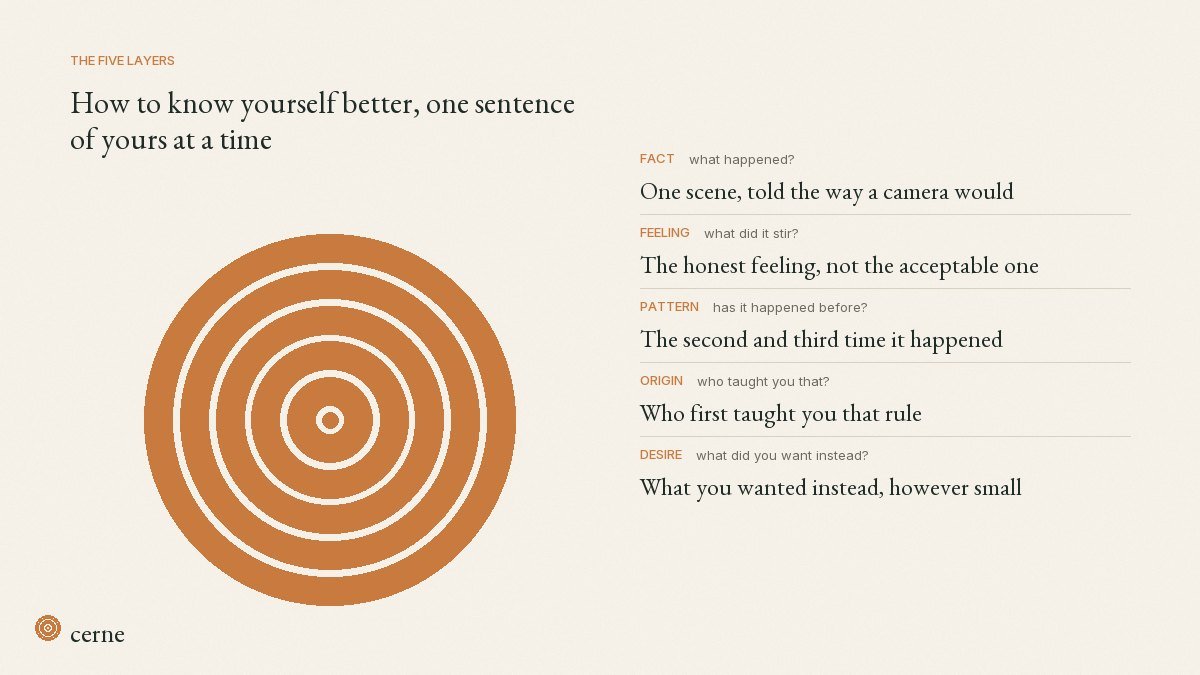
Under any question about yourself, there are five layers, and each one is a question. They go in this order because each one is easier to answer once the one before it has been said out loud. This is the method Cerne uses in every conversation, and it works on paper too.
Fact: what happened?
One scene, told plainly. Not “I always avoid conflict”, but “on Thursday my manager asked if I agreed and I said yes, and I did not.” What usually shows up here is smaller and more specific than the story you tell yourself, and that is good news, because small things can be looked at.
Feeling: what did it stir?
The honest version, not the acceptable one. In many people, the first answer is “nothing, it was fine”, and the second answer, a minute later, is the real one: shame, relief, a tightness, a wish to disappear. Both answers are fragments. Keep them.
Pattern: has it happened before?
This is where knowing yourself actually begins. You look for the second and third time, and you notice what the times have in common. Often it is not the topic. It is who was in the room, or what was at stake, or the tone of a voice.
Origin: who taught you that?
Almost every pattern has a first classroom. A parent who went silent for days. A house where money was never discussed. A teacher who praised only the finished thing. You are not blaming anyone here. You are finding out where the rule came from, so it stops looking like a law of nature.
Desire: what did you want instead?
The layer people skip, because it feels like too much to ask. And yet it is the one that turns all of this into something you can act on. What did you want, in that meeting, on that Thursday? Sometimes the answer is very small: to be asked twice. To say the number out loud. To have lunch.
When this is not enough
Sometimes you do all of this and the pattern is still there, heavier than before, because now you can see it. That is not failure. Some things are too old or too tangled to be sorted alone, with a notebook or an app, and that is what psychologists are for. If what you are finding keeps you up at night, if it touches something that happened to you that you have never told anyone, or if you feel worse every time you look, take it to a professional. Knowing yourself does not mean doing it by yourself.
And if at any point you think about hurting yourself, stop reading and call or text 988, the Suicide and Crisis Lifeline in the United States. It is free, it is open all day and all night, and there is a person on the other end.
Three small practices
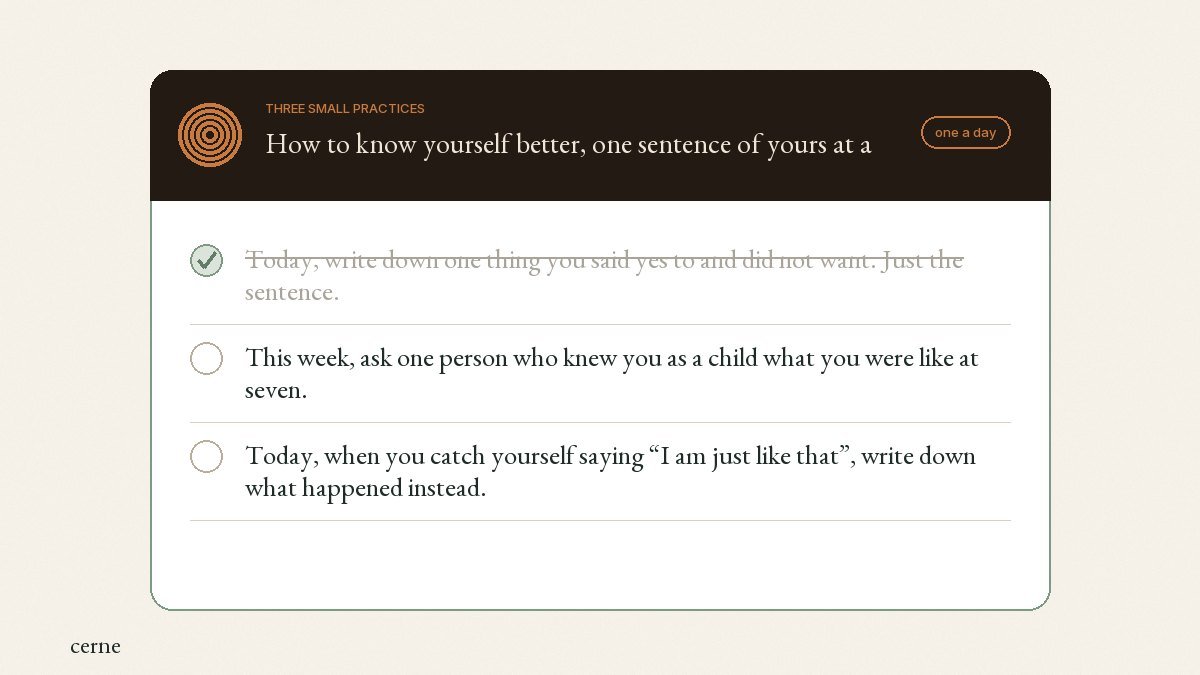
Knowing yourself is not only thinking. Here are three things in the format Cerne uses, one sentence each, small enough to actually happen.
- Today, write down one thing you said yes to and did not want. Just the sentence.
- This week, ask one person who knew you as a child what you were like at seven.
- Today, when you catch yourself saying “I am just like that”, write down what happened instead.
Quick questions
How long does it take to know yourself better?
There is no finish line, and that is the honest answer. But the first real thing usually shows up fast: one scene, one feeling you had not named, one “this has happened before”. A week of paying attention to one question tends to give you more than a year of quizzes.
Can you know yourself without therapy?
You can know yourself a great deal without therapy, the same way you can get fit without a trainer. Your own sentences, honest questions and a bit of patience go far. Therapy is for when the thing you find is too heavy to carry alone, or when you keep circling the same spot without getting anywhere.
What is the best way to start knowing yourself?
With one moment that bothered you, described as a fact. Not with your whole life. Then ask what it stirred, and whether it has happened before. Three questions, one scene, and you have started.
Do personality tests help you know yourself?
They give you a vocabulary, and that can be a comfort. What they cannot give you is your own situations: when it happens, with whom, and what you wanted instead. Use them as a starting point if you like, but do not mistake the label for the knowing.
Why is it so hard to know yourself?
Because you are the one doing the looking, and the looking is shaped by the same habits you are trying to see. Also because a lot of what we do was learned before we could choose it, so it feels like nature rather than habit. That is why it helps to work from concrete scenes and from what repeats, instead of from opinions about yourself.
Back to you
You already know more about yourself than any test will tell you. It is in the sentences you say when you are tired, in what you cancel, in what you replay at night. All you need is a way to gather those sentences and let them tell you what they have in common.
That is what Cerne does. You tap the leaf that hurts, pick a question, and talk. The app asks, keeps your sentences, and only ever concludes what your own words support. “How do I know myself better?” is one of the questions on the Me leaf. Get Cerne and start with one. If you want more questions first, read questions to ask yourself to know yourself better, and when you would rather do than think, self-knowledge exercises has more.
Everything on this page you can do with your own words.
Get the app